 Most viewed Most viewed |
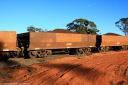
100731 02290429 viewsWOE type iron ore waggon WOE 33238 is one of a batch of twenty seven built by Goninan WA between September and October 2002 with serial number 950103-005 and fleet number 737 for Koolyanobbing iron ore operations, on loaded train 6413 at Binduli Triangle, 31st July 2010.
|
|
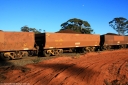
100731 02294429 viewsWOE type iron ore waggon WOE 33490 is one of a batch of one hundred and twenty eight built by United Group Rail WA between August 2008 and March 2009 with serial number 950211-030 and fleet number 8984 for Koolyanobbing iron ore operations, on loaded train 6413 at Binduli Triangle, 31st July 2010.
|
|
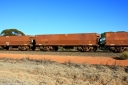
100731 02496429 viewsWOE type iron ore waggon WOE 33359 is one of a batch of one hundred and forty one built by United Goninan WA between November 2005 and April 2006 with serial number 950142-064 and fleet number 858 for Koolyanobbing iron ore operations, on empty train 6418 at Binduli Triangle, 31st July 2010.
|
|
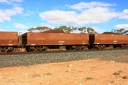
100731 02845429 viewsWOE type iron ore waggon WOE 33331 is one of a batch of one hundred and forty one built by United Goninan WA between November 2005 and April 2006 with serial number 950142-036 and fleet number 830 for Koolyanobbing iron ore operations, on loaded train 7415 at Binduli Triangle, 31st July 2010.
|
|
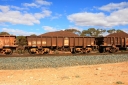
100731 02849429 viewsWO type iron ore waggon WO 31411 is one of a batch of eleven replacement waggons built by WAGR Midland Workshops between 1970 and 1971 with fleet number 187 for Koolyanobbing iron ore operations, with a 75 ton and 1018 ft³ capacity, on loaded train 7415 at Binduli Triangle, 31st July 2010. This unit was converted to WOC for coal in 1986 till 1994 when it was re-classed back to WO.
|
|
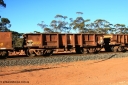
100731 03063429 viewsWOB type iron ore waggon WOB 31380 is one of a batch of twenty five built by Comeng WA between 1974 and 1975 and converted from Mt Newman high sided waggons by WAGR Midland Workshops with a capacity of 67 tons with fleet number 305 for Koolyanobbing iron ore operations, empty train arriving at Binduli Triangle, 31st July 2010.
|
|
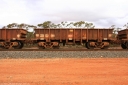
100822 5934429 viewsWO type iron ore waggon WO 31204 is one of a batch of eighty six built by WAGR Midland Workshops between 1967 and March 1968 with fleet number 101 for Koolyanobbing iron ore operations with a 75 ton and 1018 ft.³ capacity, Binduli Triangle 22nd August 2010. This unit was converted to WOS superphosphate in the late 1980s till 1994 when it was re-classed back to WO.
|
|
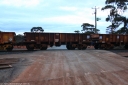
100822 6205429 viewsWOC type iron ore waggon WOC 31344 is one of a batch of thirty built by Goninan WA between October 1997 to January 1998 with fleet number for Koolyanobbing iron ore operations with a 75 ton capacity Trial waggon, on empty train 1416 at Hampton, 22nd August 2010.
|
|
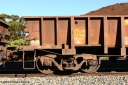
060528 4565429 viewsWOC type iron ore waggon WOC 31341 is leader of a batch of thirty built by Goninan WA between October 1997 to January 1998 with fleet number 401 for Koolyanobbing iron ore operations with a 75 ton capacity and lettered for KIPL, Koolyanobbing Iron Pty Ltd, seen here loaded with fines ore at Bonnie Vale in train number 413, 28th May 2006.
|
|
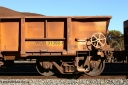
060528 4585429 viewsWOB type iron ore waggon WOB 31392 is one of a batch of twenty five built by Comeng WA between 1974 and 1975 and converted from Mt Newman high sided waggons by WAGR Midland Workshops with fleet number 317 for Koolyanobbing iron ore operations, shows the higher tare of these waggons and the capacity of 73 tons, waggon length of 10.8 metres, and a close inspection reveals that the round WAGR waggon builder's number is 31391 of 1974, this waggon cut down originally from a Comeng built Mt Newman Mining ore waggon in 1974. It was then converted to a WSM ballast hopper, then converted back to a WOB by WAGR Midland Workshops. It was originally numbered 31391 by WAGR, seen here loaded with fines at Bonnie Vale, 28th May 2006.
|
|
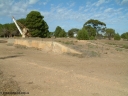
030406 091638429 viewsYeelanna, goods loading ramp and 5 ton jib crane, circa 1936. 6th April 2003.
|
|
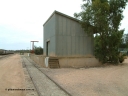
030407 104934429 viewsPoochera, south western elevation of goods shed and platform with rotating jib crane in the distance, loaded rake of grain waggons awaits pickup to the left. 7th April 2003.
|
|
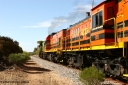
060109 2109429 viewsKyancutta, Kyancutta Tanks Rd grade crossing, ASR 830 class unit 842, an AE Goodwin built ALCo DL531 model loco serial 84140 leads EMD unit 1204 due to air-conditioning trouble and sister ALCo 851 lift the empty north bound grain train away from crew change. 9th January 2006.
|
|
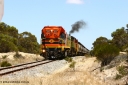
060111 2274429 viewsPeachna, Tooligie Hill Road grade crossing, empty grain train running north behind ARG 1200 class unit 1203, a Clyde Engineering EMD model G12C serial 65-427, one of fourteen originally built between 1960-65 for WAGR as their A class A 1513, fitted with dynamic brakes and financed by Western Mining Corporation, started working on the Eyre Peninsula in November 2004. 11th January 2006.
|
|
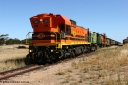
060111 2333429 viewsWarramboo, located at the 190.2 km and opened with the line in May 1913, with now disused station building on the left, Clyde Engineering built EMD G12C model loco 1203 serial 65-427 stands on the mainline as loading on the grain siding has started. 11th January 2006.
|
|
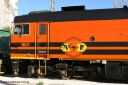
060113 2448429 viewsThevenard, class leader 1601, a Clyde Engineering built EMD model JL22C serial 71-728, originally built for the Central Australia Railway in 1971 as NJ class leader NJ 1 'Ben Chifley' and transferred to the Eyre Peninsula in 1981. 13th January 2006.
|
|
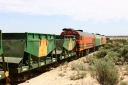
060113 2492429 viewsKevin, the triple NJ-1600 class combination of 1604, NJ 3 and 1601 pull the empty gypsum train 6DD3 along the Penong line prior to reversing around the triangle. 13th January 2006.
|
|
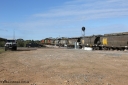
130704 0411429 viewsKyancutta, south bound loaded grain train has stopped here to collect a loaded rack of grain waggons, seen here backing up to re-join the rest of the train on the mainline as it crosses the Eyre Highway grade crossing and one of only three electric signals on the network, behind EMD 1204 and twin ALCo 830 units 873 and 851. 4th July 2013.
|
|
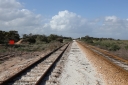
130704 0499429 viewsMoule, looking east, Moule located at the 445.6 km was opened in February 1966 when the Direct Line between Ceduna and Kevin was opened. From the left is the end of the ballast siding with the crossing loop rejoining the mainline just before the grade crossing to access the ballast stockpile area. Location is here. 4th July 2013.
|
|
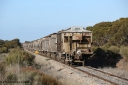
130705 0665429 viewsLock, HBN type dual use ballast / grain hopper waggons, HBN 11 still with side gangways in place. One of seventeen built by South Australian Railways Islington Workshops in 1968 with a 25 ton capacity, increased to 34 tons in 1974. HBN 1-11 fitted with removable tops and roll-top hatches in 1999-2000. 5th July 2013.
|
|
| 19220 files on 961 page(s) |
 |
|
|
|
|
|
|
|
549 | |
|
|
|
|
|
|
|
 Login
Login

